
Shenyang Total Bearing Co., Ltd.
16 years of industry experience, strong development, OEM / MRO
Technical consultation:
0086-24-22923833 0086-24-24853899
0086-24-22923833 0086-24-24853899

 NTN
NTN
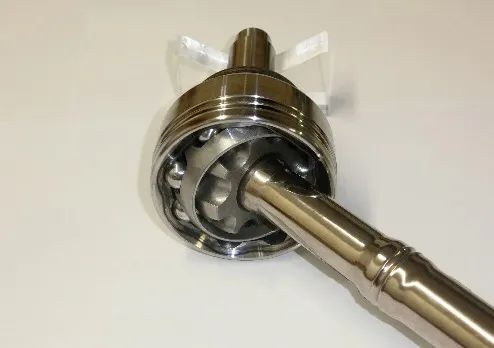
NTN has received mass production orders for the CFJ, a high-efficiency fixed constant velocity universal joint, from a number of automotive manufacturers. While maintaining the basic characteristics of the fixed CVJ "EBJ", the "CFJ" offers excellent compactness and light weight, reducing the torque loss rate by more than 50%.
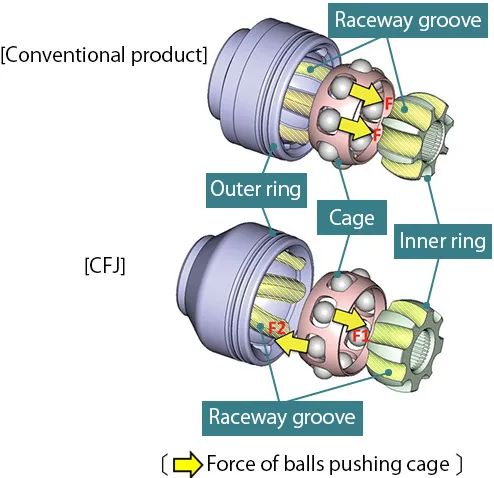
When a constant velocity universal joint transmits torque, the ball as an internal part pushes the cage in one direction, causing friction between the parts and torque loss. In addition, as the operating angle of the constant velocity universal joint increases, the force of the ball pushing the cage increases, resulting in an increase in the torque loss rate. The "CFJ" adopts NTN's unique "spherical cross-groove structure" in which adjacent races (raceways) are inclined to each other to distribute the force in alternating directions, reducing the torque loss rate by more than 50% compared to conventional products. In addition, the proprietary structure significantly suppresses the increase in torque loss rate even when the working angle of CVJ increases.
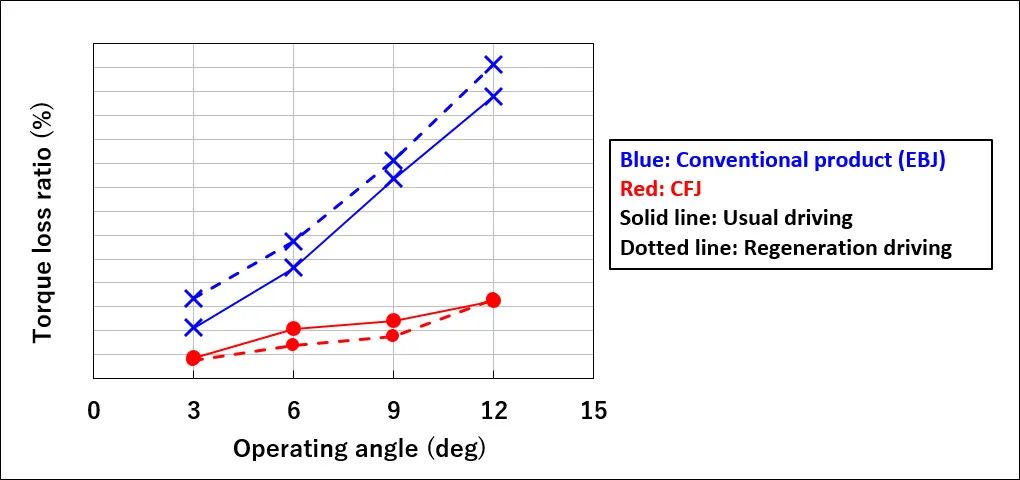
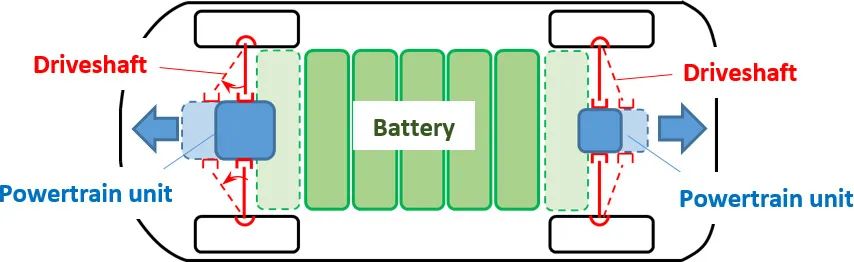
In EVs, considering the installation of large-capacity batteries, increased interior space and crash safety, powertrain units tend to be installed at the rear of the vehicle, so the operating angle of the CVJ increases. The "CFJ" contributes to the flexibility of vehicle layout and saves electricity, as it exhibits high efficiency even at large operating angles, and EVs and HEVs are equipped with a recovery braking system that generates and stores electricity through the motor when the vehicle is slowed down. The proprietary structure of the "CFJ" also reduces the torque loss rate, thereby improving recovery efficiency.
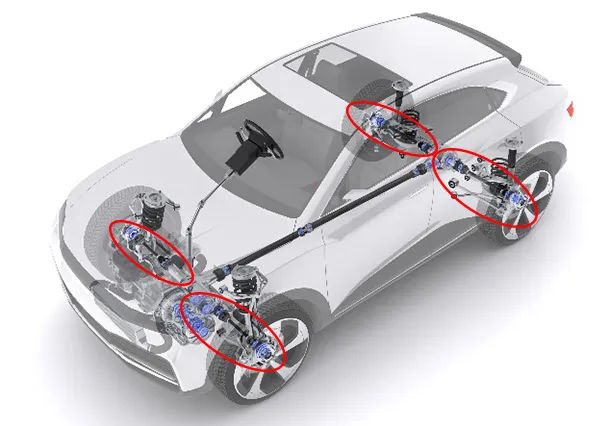
Under the JAPIA LCI calculation method, the fuel efficiency of a vehicle with an internal combustion engine that replaces the EBJ with a CFJ is expected to increase by 0.62% and CO2 emissions will be reduced by 0.96g/km. The CFJ's high environmental performance is highly valued by automakers as CO2 emissions regulations become increasingly stringent. The CFJ is highly regarded by automakers for its high environmental performance.

Fax:0086-24-88729249
Email:sales@totalslewing.com totalsycn@gmail.com
Addres:506 Shengjing bulding, 11 Shenyang Road, Shenhe District, Shenyang City
Postcode:110014
0086-24-22923833 0086-24-24853899

Scan wechat
Learn more

